The full story
I have lived in and around addiction and trauma in more forms than most people know exist.
I grew up in it. I survived it. I fought my way out — not once, but over and over, under conditions that would have ended most people. I know what it feels like when the system doesn't have a place for you. I also know what it feels like to refuse to stop fighting until you find your way out the other side.
The First Fourteen Years
I am a male domestic violence survivor with fourteen years of continuous sobriety, earned while doing my absolute best to be a father and grow a beautiful family I started in my early twenties. I am a former rail car electrician who was electrocuted on the job and spent years fighting a medical and legal system that failed me at every turn. I live with bipolar disorder, PTSD, severe anxiety, ADHD, OCD — what today often gets folded into a single diagnosis of CPTSD. I navigated the treatment system not as a passive patient but as someone who showed up — to facilities, to appointments, to detox at home when I had to — week after week, year after year, because stopping was never an option I was willing to accept.
My recovery was not linear. But it was relentless.
Addiction vs. Dependence
What most people don't talk about — and what the treatment system rarely acknowledges — is the difference between addiction and dependence, and how that distinction keeps people trapped. For many people in long-term medication-assisted treatment, the dependency itself becomes a barrier — not because the medication isn't working, but because the infrastructure around it doesn't teach people how to live within it.
I spent roughly the first half of my time in MAT learning to manage my own dependency. The second half, I figured out something most people never do: how to maintain genuine stability inside that framework. Not perfectly — but to the absolute best of my above-average abilities. Too many people don't have the support, the passion of a parent fighting for their kids, or the will power of a lion to do this alone.
If you have a dream, a passion, a purpose you're still searching for — start. Fail fast, fail honestly, and learn the hardest lessons the work will give you. The lessons that hold up are forged under pressure, not in comfort. Then you turn around and share them.
The Coach Who Wasn't a Coach
Once I had stability, I started doing something that felt natural — helping the people around me do the same. I became, for lack of a better term, a life coach. Not officially. Not with a credential. But practically — helping friends navigate recovery, stay on track, balance their finances, make it through the week.
I helped one friend get to a treatment facility in Florida. He met a woman there. He's been sober for years now, working his way up at a car dealership, golfing, smiling in pictures. He came back to New York at one point, considering his old factory job — good money, terrible environment. He asked my advice. He walked out my door, got in the car with his partner, and drove south and didn't stop.
That's one good ending. I've seen a lot of those. I've also seen the other kind.
The $4,800 Indictment
When I started researching ketamine-assisted therapy, I did what I always do — I went deep. I found a facility in Rochester offering four sessions for $4,800. I called. I asked about the protocol. They would inject you and walk you back out the door. No therapist. No music therapy. No cognitive behavioral support. No integration. Nothing. Just a shot, a 90-minute drive home, and a bill.
Read that again. Four thousand eight hundred dollars. A drug known to crack people wide open. And no one in the room when it happens.
I was ready to do it anyway — because I was that desperate for something that worked — but I kept researching. I found online resources, therapeutic frameworks, integration practices. I built my own protocol. I did a better job of designing a proper ketamine treatment experience than the hospital that was charging nearly five thousand dollars for it.
That's not a brag. That's an indictment of the current state of psychedelic-assisted therapy and most medical care access in this country.
The treatments work. The evidence is clear. The problem is access, education, and infrastructure. Too many facilities are slapping together a building, hiring providers who want a paycheck, and calling it treatment. No proper intake. No patient-modality matching. No therapeutic support. No outcomes tracking. No follow-up. Just a drug administered in a clinical vacuum and a patient sent home to figure out the rest alone.
DBATR Exists to Fix That
DBATR is the link. Not the provider, not the facility, not the government office — the link that connects every person, place, and resource in one place, with the click of a finger. AI-guided intake. Proper patient-modality matching across four evidence-based psychedelic-assisted therapy modalities — ketamine, psilocybin, ibogaine, and MDMA-assisted therapy — alongside other forms of treatment and support. Pharmaceutical-grade supply chains. Clinical oversight. Integration. Outcomes tracking. And a training arm that reaches the people who work with these populations every day — first responders, social workers, corrections officers, employers — and gives them the tools to actually help.
AIBES — A Third System
And now a third system: AIBES — AI-Orchestrated Institutional Backlog Elimination. Because I met a man who was sitting in jail not because of a judge's decision, but because Albany was six months behind on paperwork. That's not justice. That's a processing failure.
AIBES uses the same AI orchestration architecture to identify, prioritize, and eliminate document backlogs across courts, public defender offices, corrections, benefits agencies, and healthcare systems — prioritizing the people whose lives are most directly affected by the delay. Three patents. One mission. One platform.
A Sixth Sense, Earned
I am not a researcher by training. I am an electromechanical engineer by education and a survivor by experience. I have a sixth sense for what people in crisis need — not because I studied it, but because I lived it, and because I have spent my adult life being the person others call when they don't know where else to turn.
I have existing relationships with treatment facilities, therapists, recovery organizations, and advocacy groups throughout the Buffalo/Niagara region. I have clinical providers who have watched my recovery for a decade and are willing to stand behind this work.
I filed three provisional patents between April and May 2026. I formed an LLC in New Mexico. I obtained an EIN. I registered with SAM.gov. I built a complete NIDA SBIR Phase I application. I launched a product with Stripe payment processing. I did most of this with no funding, no team, and no roadmap — just the knowledge that this needed to exist and the stubbornness to make it happen.
The Turning Point
The turning point came from an unexpected place. A legal battle over child support — a magistrate imputing income I couldn't earn because I couldn't leave my bed — forced me to research. And in that research, I found something I'd never found before: language from new studies on male domestic violence. Terminology that gave words to experiences I'd carried for decades without being able to name them. That language changed everything. It gave me the ability to be understood. To understand myself. To build a network I didn't know I'd already created on my journey.
That's when DBATR stopped being an idea and became a mission.
I love myself. I love my kids. I love and appreciate my life like I've never been able to before. I'm not just free — I'm grateful. More than ever. For every success, every failure, every person who showed me or others kindness. I've gathered every bit and piece from it all, and I'm so excited to share it.
No More Hiding
There was a moment — quiet, unwitnessed — when I realized the walls I'd built to keep trouble out had also been keeping me in.
I am done being scared. Done hiding. Done being squeezed into a cage so tight it felt like being weighted to the bottom of the ocean, helpless, where even I could start to feel hopeless. I have been there. I did feel that.
The rock bottom I hit was deeper than the alcoholic version of me ever knew. The climb back was steeper. But the roar on the other side is real — and it belongs to anyone willing to do the work. Here is the playbook I keep finding underneath every chapter of my life worth talking about:
Imagine the lowest point you have survived — then match it with the opposite pull: becoming your best self and shining that out to the entire world. The cries that come with feeling like you have to walk away from the love of your life — not because you do not care, but because the toxic nature and the trauma you both carried, the poor education and broken role models, the flawed compass you were handed, made staying feel like drowning together. We never gave up. Even when family, friends, and every authority around us said we should.
- Move without fear. Start before you feel ready.
- Make the mistake — then look honestly at what went wrong, on your side and the other side.
- Name it out loud. Accept your flaws and your faults.
- Apologize from the depths of your heart, not the surface of your mouth.
- Let yourself feel it when it hurts — especially the moments that feel like losing the love of your life.
- Then stand back up and do the next right thing, even if you can only see ten feet of road ahead.
The lessons that hold up are forged under real pressure. Then you turn around and share every bit of them.
The Relationship That Almost Ended Us Both
I considered cutting this section entirely. I left a shorter version in because the whole purpose of this page is that nobody should have to bury their story to be taken seriously.
For years I was in a relationship with a partner carrying her own significant trauma and a serious mental health diagnosis. I was carrying mine. Two deeply wounded people, full pressure, no buffer between us. The honesty we somehow held onto was rare. The harm we did to each other was real. Both of those things can be true at the same time.
Underneath all of it, I could still see her — the actual human being, not the diagnosis, not the worst moments. We did not lie to each other, and that is more than most people get.
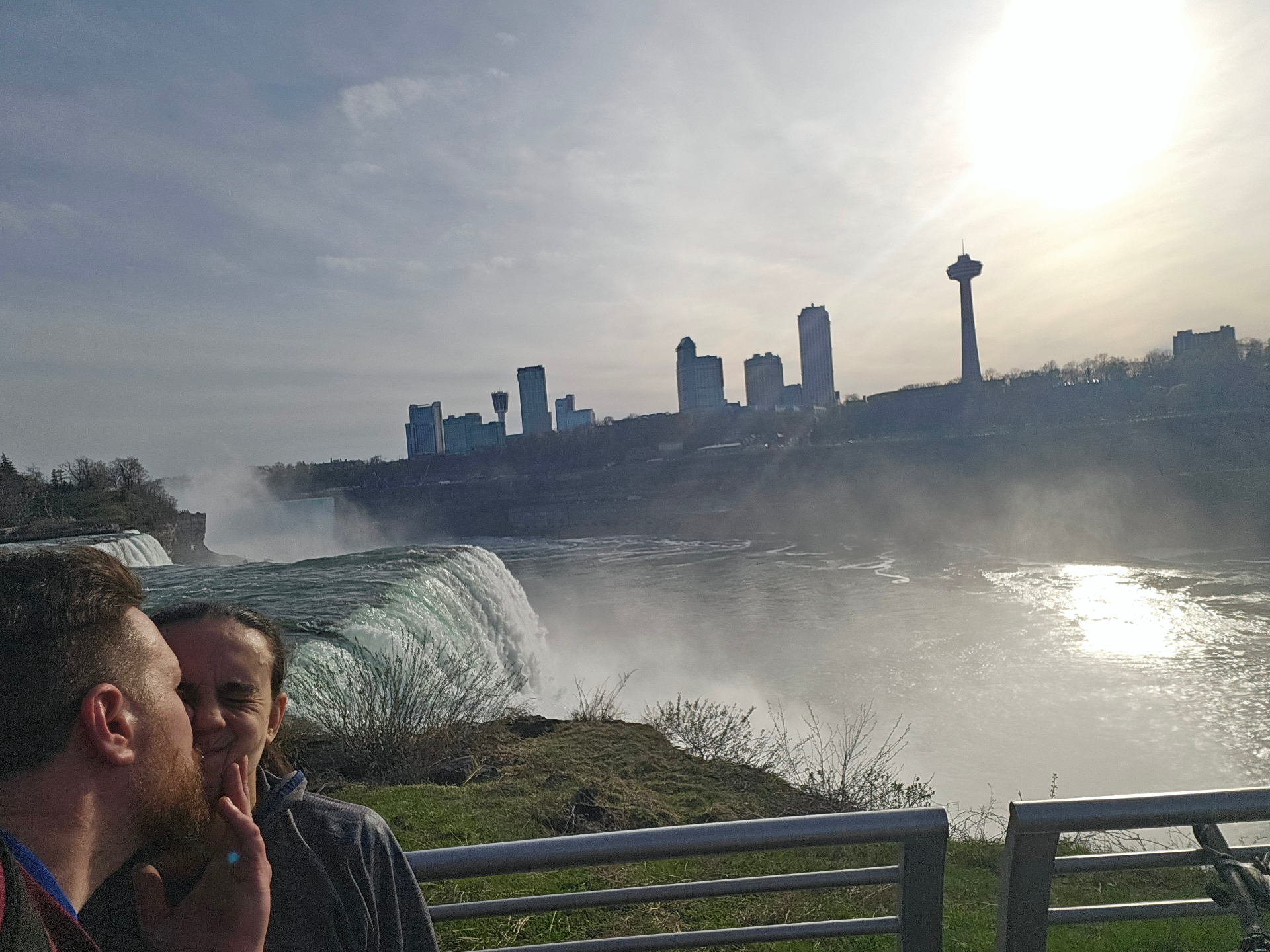
We are still together. Everyone in our lives — family, friends, professionals, the courts — told us to walk away. We refused. Two people who would not quit on each other while the world kept handing us reasons to. That is its own kind of recovery, and it is part of why I am able to build this.
DBATR exists because the people most likely to be hurt in this country are the people least likely to have somewhere safe to go. That has to stop. I am one of a thousand reasons it has to stop.
I'm telling these stories — mine, the ugly ones, the ones most founders bury — because the whole point of this platform is that nobody should have to bury theirs to be taken seriously. If you've read this far, you already know whether some piece of this is yours too. The link you needed is being built. I'm just barely the beginning.
A Mind Built to Stress-Test
My mind runs like a controlled stress-test of every system it touches — not because I want anything to break, but because I want to know what is real. I will pressure-test a belief, a relationship, a protocol, my own recovery, and watch what actually holds. That is how I learned which of my treatments were theater and which ones held weight. It is how I learned who answers the phone at 3 a.m. and who does not. It is how I am building this.
That's the mission. That's always been the mission.
The Hard Way
Do it the hard way. Lead with grit, with morals, with good faith toward others and real respect for yourself. Keep your dignity — or work to get it back. It is not too late.
Do the right thing over the cheap thing, the easy thing, the most profitable thing. Restructure. Reinvent. Reinvent yourselves, your businesses, your models. We do not really have another option — so bite the bullet, and let us rebuild inside the structures that already exist, starting now.
See It at the Core
Remember all of it — the good times and the bad times that made you you. That favorite color attached to a memory will associate your favorite something, the thing that gives you a warm fuzzy, with those moments. Happy and pleasure, kindness and consideration, compassion and care — in a mindful and conservative manner, in everything you do, who you are, who you want to become. This stuff isn't rocket science. It's common sense. Common courtesy. Common what's-supposed-to-be everyday stuff.
If we all get on board and we all work together, we can do this quickly. And believe me, it's possible — because I did all of this very, very quickly, with nothing but a few hundred bucks and eight different biggest, most complex things going on all at once, right after the lowest point most anyone's ever been, getting hit from everyone, everywhere, everything.
To everyone who made it harder than it had to be: thank you. You woke me up. I wish nothing but the best to everyone. Expect nothing, want nothing — except the chance to pass it on.
Let's do this.